Fireplace Efficiency in Subzero Weather: Getting Real Heat When It's 20 Below
On the coldest Ohio nights an open fireplace can send more heat up the flue than it gives the room. Draft, dampers, doors and dry wood — how to make yours a net win.
The short answer: an open fireplace fights your furnace unless you help it
Here is the uncomfortable arithmetic of a subzero night. A roaring open fireplace can pull hundreds of cubic feet of heated room air up the flue every minute — air your furnace paid to warm, replaced by cold outside air leaking in around doors and windows elsewhere in the house. The radiant heat near the hearth is real and wonderful, but a fireplace run carelessly at 20 below can leave the far rooms colder than if you had never lit it. The good news: the losses are not mysterious. They come from four places — a cold, reluctant flue; a damper that leaks heat around the clock; heat that never gets pushed into the room; and fuel burned too cool to give its heat up. Fix those four and the same fireplace becomes what it was meant to be in an Ohio January: a genuine second heat source that takes load off the furnace exactly when the furnace is working hardest.
Start with the cold flue — draft is everything
When it is 20 below outside and the flue has sat cold, the column of air inside the chimney is dense and heavy, and it wants to fall into the house rather than rise. That is why the first fire of a cold snap so often smokes into the room for the first minutes. Prime the flue before you build the fire: open the damper fully, and warm the flue gently — holding a lit roll of newspaper up near the damper for a minute is the classic trick — until you feel the draft reverse and pull. Build the fire toward the back of the firebox, where its heat goes straight at the flue opening, and start with a fast, bright kindling fire rather than a slow pile of big splits. Once the chimney is warm and drawing, it will pull steadily all evening. If your fireplace chronically drafts poorly on cold days — smoke rollout, a cold downdraft smell when no fire is lit — that is not a quirk to live with. It is a sizing, height or blockage question, and an inspection answers it.
The damper: your biggest silent heat leak
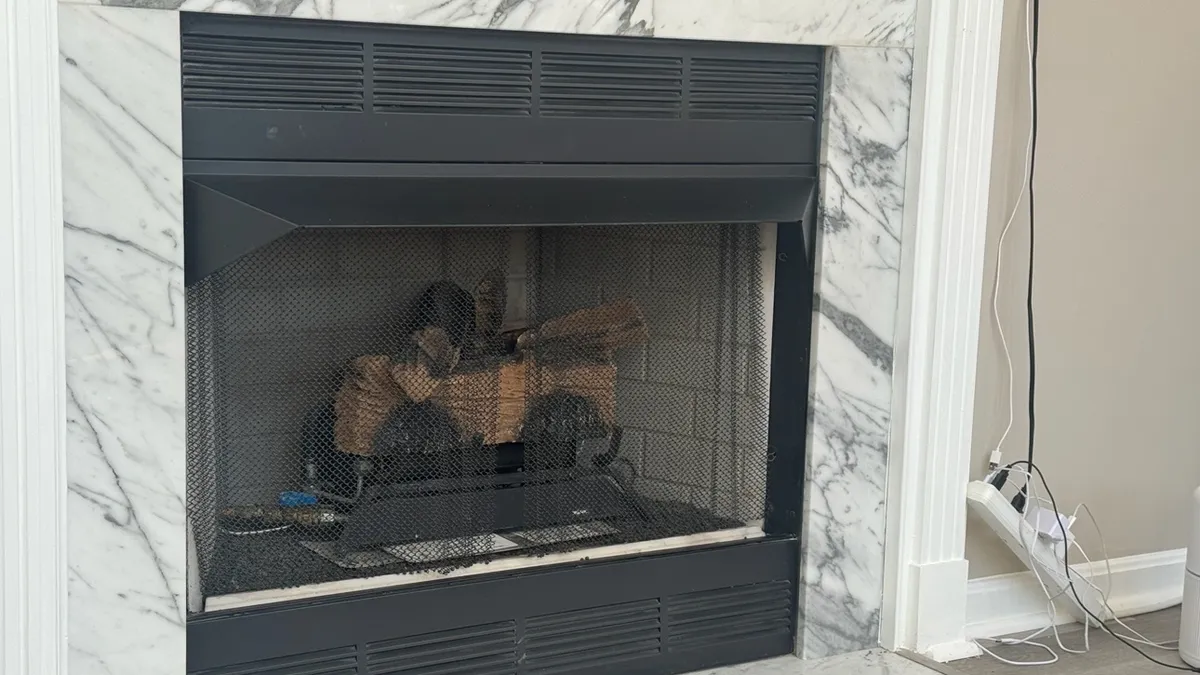
A traditional throat damper is a cast-iron plate that never truly seals — it sits in a metal frame, warps with heat over the years, and leaks heated air up the flue twenty-four hours a day, fire or no fire. In an Ohio winter that leak runs for six months: stand near the fireplace on a still, cold night and feel for the draft with the back of your hand. A top-sealing damper, mounted at the chimney top and operated by a cable, closes with a silicone gasket against the flue — it seals like a jar lid, keeps animals and weather out at the same time, and pays for itself in stopped heat loss. Glass doors are the other half of the fix while a fire burns: they cut the room-air draw dramatically, keep the radiant heat coming through, and let you close the system down safely as the fire dies. Between the two, most open fireplaces stop being a liability on the heating bill.
Fuel and fire management: heat is a technique
What you burn decides how much heat there is to keep. Dry, seasoned hardwood — split and stacked under cover for six to twelve months — burns hot enough to radiate real warmth; wet wood spends its energy boiling off water and sends the difference up the flue as creosote. Burn smaller, brighter fires rather than one huge smoldering load: an active flame with glowing coals gives steady radiant heat, while a choked, smoldering fire gives smoke and tar. Reload on the coal bed a few splits at a time, keep the fire toward the back of the box, and let about an inch of ash insulate the floor — ash is insulation for the coals, not dirt to be scrubbed away after every fire. A simple grate that lifts the wood slightly improves airflow under the fire and evens the burn. None of this is fussy — it is the difference between a fireplace that heats the room and one that mainly heats the outdoors.
When the real answer is an insert
Sometimes the honest conclusion of an efficiency conversation is that an open masonry fireplace has a ceiling on what it can do — it was designed in an era of cheap fuel and leaky houses, as much for cooking and light as for heat. A modern wood or gas insert changes the equation entirely: a sealed, insulated unit set into the existing firebox, vented through a new liner, that converts most of the fuel's energy into room heat instead of flue loss, with glass that stays clean and a fire you can actually control. If your fireplace is your main supplemental heat through an Ohio winter — or you want it to be — that is the upgrade worth pricing. Start with an inspection so the recommendation fits your chimney — and through the fall our checkup bundles a sweep and inspection in one visit. Call Eagle Chimney Ohio at (614) 412-3139 or request a free estimate through our contact form, and we will tell you honestly what your fireplace can do this winter — and what it would take to do more.
Related Services & Service Areas
Need Help With This?
Our related service: Fireplace Services — Expert fireplace cleaning, inspection, repair and installation — including wood and gas stoves, pellet stoves, inserts and glass doors — for homes and businesses.